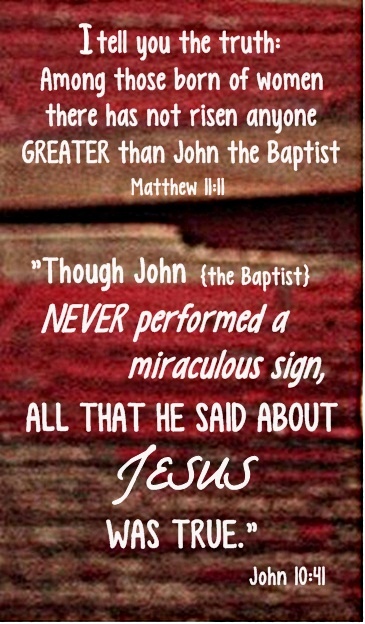
“A greater than John the Baptist has never been seen” (Mt 11:11)
Some years back, a young lady walked into my office. She had arrived in a big car; she was well dressed. She said, she had a good job. She was in a steady relationship. She must have been in her late twenties. Everything was set for a happy life. But as she settled down, she said, she was not happy in her life. What was wrong, I wondered. Our continued conversation revealed that she was not in the right place. That “good job” was not what her heart was wanting. She was dealing with papers in her office, but her heart wanted a context where she could directly interact with people. The lesson for me out of that conversation was: our happiness and well being are directly correlated to finding the right space in the universe.
During the season of Advent, one of the persons that the Liturgy of the Word draws our attention to is John the Baptist. To me, John the Baptist was a man who knew his space in the universe even before his birth, and in his life and death he went on to live the mission for which he was born on the face of the earth.
When John was born his father prophesied, “And you, little child … you will go before the Lord to prepare a way for him, to give his people knowledge of salvation through the forgiveness of their sins” (Lk 1:76-77). And that is exactly what John the Baptist went on to fulfil in his life. He never exaggerated his space. He had opportunities to declare himself as the messiah. In the Gospel of John, “when the Jews sent to him priests and Levites from Jerusalem to ask him, ‘Who are you?’ John declared, he did not deny but declared, ‘I am not the Christ’…I am, as Isaiah prophesied: A voice of one that cries in the desert: Prepare a way for the Lord. Make his paths straight” (Jn 1:19-22). When Jesus would appear on the scene he would point out Jesus as the Lamb of God (Jn 1:36), and he would agree to exit (Jn 3:30).
In today’s gospel text, we find John already in prison. He knows his end is near, so he wants to double check if his mission is complete. Has the messianic times arrived? “Are you one who is to come, or have we got to wait for someone else?” He sends his disciples to enquire of Jesus himself. And Jesus assures John, through the disciples of John the Baptist, “Go back and tell John what you hear and see…” The signs are clear.
And for John, it is “nunc dimittis” – Let my servant go! And Mark 6:17-29 describes the drama around the death of John. Even though his life would end in an untimely death (Mt 14:1-12), that death itself was in fulfilment of why he was born on the face of the earth. In John 10:41, people attest, “John never performed a miraculous sign, but all he said about Jesus was true.” And in the gospel of today, Jesus offers the best certificate, “I tell you solemnly, of all the children born of women, a greater than John the Baptist has never been seen…” (Mt 11:11).
The greatest challenge in our own life is in finding our space in the universe. We call this, ‘Will of God’. I would call it, the dream that God has for us. God created us in a unique way for a unique purpose. There is a unique space in the universe for each one of us. If I do not fill that space I would leave a vacuum in the history of the universe. On the other hand, our own happiness and wellbeing consists in finding that space and meaningfully filling it. Often in our prayers we ask God to give us this and give us that. Essentially we need to listen to God – listen to his dreams for us. When our desire meets with the desire that God has for us, it is like, the whole universe moves for us. We experience fulfilment.
Let the example of John the Baptist challenge us to get deeper in our discernment of the will of God for us.