 30th Sunday of the Year
Love!
It is said that at the time of Jesus the rabbis could count up to 613 commandments contained in the Law: 365 were prohibitions (don’t do this!) and 248 were prescriptive (do this!). Some of the rabbis considered all these commandments to be equally important, while others continued to debate to identify the most important commandment. That is why the Pharisees and Sadducees had reasons to ask Jesus, “Which is the greatest commandment of the Law?” even if their intention was only to put Jesus to the test. Apparently Jesus gives an answer that is similar to those given by some of the rabbis of his time. For instance, there is a story about one rabbi Hillel, who lived a few years before Jesus. A gentile went to […]
Sunday Sermons
Sunday Sermons and Homilies
Sermon for Cycle A – 29th Sunday Homily
 “Give to Ceasar what belongs to Caesar – and to God what belongs to God”
Being Good Christians and Honest Citizens
In many aspects of his public life Jesus seems to be a rebel. He blatantly disobeys the Sabbath law (Jn 5:1-19; Lk 13:10-16; Mk 3:1-6). Not only did he break the law but allowed his disciples to do the same (Mt 12:1-14). Jesus questioned the rationale of the Law of Moses and offered a new interpretation (Mt 5:1-7:29), even though he claimed, “I have come not to abolish them but to fulfil them” (Mt 5:17). Jesus challenged the powers-that-be: the priests, the lawyers, the scribes, the Pharisees and the Sadducees. And yet, in the gospel reading of today Jesus tells the Pharisees and the Herodians to continue ‘to pay taxes’ to the Romans. What […]
Sermon for 25th Sunday in Ordinary Time – Year A Homily
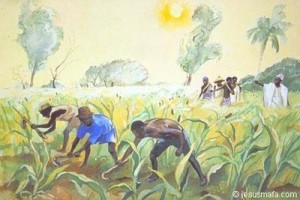 God’s ways may not be fair, but they are full of love
It is not fair: At the Nairobi airport, I was once in the company of a large European family – the parents with seven children of varying ages – waiting to board a plane. At one point, the mother began to distribute chocolates to her restless children. Everyone was given a chocolate bar each. Finally, there was one left over. The mum gave it to the eldest girl. One of the other children, who might have been about four years old, blurted out in a spontaneous cry for justice, in a tone that was also uniquely childish, “Mom, that is not fair!” They all had a hearty laughter. While they admired the four-year old for her strong sense of justice, […]
Sermon for Cycle A – 24th Sunday Sermon: Experiencing Forgiveness

The need to experience forgiveness (Mt 18:21-35)
24th Sunday in Ordinary Time – Cycle A
When people (especially the young) ask me, why we Catholics have to go to a priest for confession, and why can’t we confess our sins directly to God, I try to offer them several reasons as to why I myself go for confession. One of the more meaningful answers that I give is: I want to hear through a human voice that God has forgiven me. This reason is consistent with the theology of sacraments – visible signs of internal grace.
When I was making the 30-day Ignatian Spiritual Exercises, one of the high points during that retreat was the celebration of the sacrament of reconciliation. After the first eight days of silence and prayer, memories of hurt and […]
Sermon for 22nd Sunday in Ordinary Time – Year A Homily
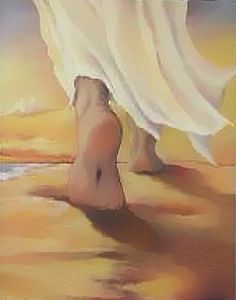 If you want to be a follower of mine…
An online dictionary offers four possible meanings for the word ‘devotion’. I would reduce the four definitions to two:
(a) earnest attachment to a cause, person, etc.
(b) a form of prayer or worship for special use.
My reflection this morning is on the significance of these two points for our Christian life journey – being disciples of Jesus wholly ‘devoted’ to him, and living the Christian spirituality in our daily lives. In classical Christian literature, the word ‘devotion’ is often used in place of the more contemporary word ‘spirituality’. For instance, the classical work of St Francis de Sales is entitled, Introduction to the Devout Life. By ‘devout life’ he simply means spirituality and fulfilling the universal call to holiness. In short, my reflection is about spirituality – based on the Liturgy of the Word on this 22nd Sunday in ordinary time. What is spirituality?
Spirituality is letting ourselves be […]