 C’mon and Celebrate!
(Is 25:6-10; Phil 4:12-14,19-20; Mt 22:1-14)
In most cultures a meal is an occasion for coming together. It is communitarian. It is a fellowship. That is why, even people eating alone in trains and buses might invite others to join them, and if forced to eat alone, they would do it rather awkwardly.
In the context of a meal, strangers become friends (Lk5:29), and even enemies become covenantal partners (Gen 26:26-31). No wonder then, meal or celebration is used in the Gospels as a powerful image of the Kingdom of God (or the ‘Kingdom of Heaven’, as the Gospel of Matthew has it).
1. Life in God is a celebration
Yes, the Kingdom of God is a party! The book of Deuteronomy (14: 22-23), says, “Every year, you must take a tithe of what […]
Sunday Sermons
Sunday Sermons and Homilies
Sermon for Cycle A – 27th Sunday Homily: Avoiding Spiritual Redundancy
 Are you protected against Spiritual Redundancy?
27th Sunday in Ordinary Time – Cycle A
(Isaiah 5: 1-7; Psalm 79; Philippians 4: 6-9; Matthew 21: 33-43)
Down-sizing, Redundancy, and laying off are common in the capitalistic world. Often, it is a painful experience for individuals. One danger is for people to take it too personally when they are laid off. In most cases redundancy is not a statement on our self-worth as individuals. Redundancy might have nothing to do with an individual’s talents and skills. Simply, the game of Monopoly that is being played by the corporate world should not make us feel that we are worthless. To the people who have been made redundant, it might seem insensitive to repeat the words of the 2nd reading of today: “There is no need to worry…” […]
Sermon for Cycle A – 26th Sunday Homily: First Impression
 First Impression is not good enough in the Kingdom of God
In your social interactions, have you come across individuals who make a very good first impression on you? After a few minutes of conversation with you, they address you by your first name; they talk as if you have known each other for years; and they look at you as if you are the only one who matters to them. And then, after a few months you come across this person and you approach them with the same spirit of familiarity that they exhibited to you in your last meeting, but alas, they don’t know you from Adam! And to add to your disappointment, they are embarrassed, or even show some annoyance that you want a favour from them!
On the other hand, there are others who might look grumpy, aloof […]
Sermon for 23rd Sunday in Ordinary Time – Year A Homily
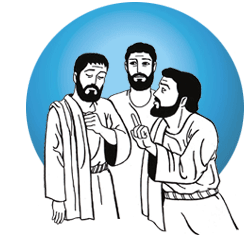 The Christian in Dialogue (Mt 18:15-20)
Faced with an enemy or an unjust aggressor, an animal has basically three possible responses (3 F’s): Flight, Fight and Freeze. Faced with an unpleasant situation we humans too have the these options. What do you do when we come across situations we don’t like in the street, or even in our parish community? But we humans have a fourth option: dialogue. We can use our gift of reason to appeal to others’ reason. We can appeal to the goodness of the heart of others. This presupposes a basic trust in the goodness of human nature itself, namely, that others are capable of reasoning and feeling just as I do.
In the gospel passage, Jesus tells us how we could be dealing with unchristian attitude and behaviour in our communities. It is interesting to note that, in the text […]
Sermon for Cycle A – 21st Sunday Homily: Who is Jesus?
 But you, who do you say I am? (Mt 16:13-20)
21 Sunday – Year A
In my mother tongue, Tamil, while speaking about great people, speakers and writers often refer to: “the Buddha, Jesus and Gandhi”. These three persons are mentioned as a matter of fact in the same breath. We Christians may feel proud that even non-Christians refer to Jesus as a great man. Looking at it at a deeper level, this expression may not reflect the authentic experience of Jesus.
Who then is Jesus for you? Is he merely a great man? The gospel text of today once again invites us to reflect on this question.
This event – of Jesus asking his disciples – “Who do people say the Son of man is?” and “But you, […]