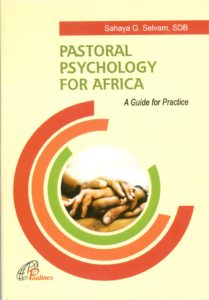
 Selvam, S.G. (2019). Pastoral psychology for Africa: A guide for practice. Nairobi: Paulines Africa.
READ: AN ACADEMIC REVIEW OF THIS BOOK
In pastoral practice, good will is not good enough. We also need a scientific approach. Psychology can provide a framework for a systematic approach in pastoral care.
Psychology for Pastoral Practice in Africa is designed to offer a scientific framework for Christian ministry in traditional societies such as Africa. The approach is ecumenical and Catholic. It is scholarly and accessible.
The book has 30 chapters grouped into five parts:
1. Psychology and Pastoral Care
2. The Person of the Pastoral Practitioner
3. Along Life-Long Development
4. Anomalous and Religious Experiences
5. Groups and Individuals
Outline of a Typical Chapter
Each chapter discusses one particular problem or situation in the pastoral context, sheds light on the problem by having […]
Publications
Publications
“Moulding his human personality”: Personality change and formation to priesthood in the Catholic Church
 “Moulding his human personality”: Personality change and formation to priesthood in the Catholic Church
Sahaya G. Selvam
Abstract
The official documents on formation to priesthood in the Catholic Church encourage the use of personality psychology. Generally, the documents understand human personality to be dynamic. What does this mean in the light of the contemporary debate on the psychology of personality change? This article attempts to summarize the salient features of this debate, pointing out its relevance to priestly formation. Supporting a “whole-person model” of personality as proposed by Dan McAdams, the article considers the possibility of personality change at some levels in the context of religious experience facilitated by seminary formation. This article is also aimed at enlightening formation guides to make an informed decision in the choice of appropriate models of personality in the accompaniment of their candidates.
Keywords
formation to priesthood, psychology of personality, personality change, whole-person […]
Benefits of Good Shepherd Catechesis
{{unknown}} Benefits of Good Shepherd Catechesis among Children with Intellectual Disabilities in Kenya
by
Sahaya G. Selvam
Lucia Munyiva
Abstract
Since Martin Luther, religious education has largely been identified with catechism that used question and answer method, particularly in the Catholic church. For a person with intellectual disability, this offers a grave difficulty in religious formation. Could there be alternatives? The present study aimed at exploring the benefits of Catechesis of the Good Shepherd (CGS) for children living with intellectual disabilities. The participants were 23 children and 9 care-givers in a Catholic context in Kenya. Observation guides and interviews were used to collect data that showed that children with intellectual disabilities had the ability to spontaneously relate with the spiritual world, and in some cases, with Jesus. The findings confirmed that the CGS offers children with special needs the space, tools, and time to get in touch […]
Defining Youth: Pastoral Implications for Africa
 “Youth” is a greasy term that slips out of the grip of any definition. Yet, everyone talks about youth, in academics, pastoral ministry, and daily life. Is the concept of youth that straightforward? Take, for instance, the age criterion in defining youth. The age-range could be as low as 12 years, as it is the case in the Ugandan Youth Policy (Uganda, 2001), and as high as 35 years, as in Kenyan constitutions, or even 40 years as in Malaysian Youth Policy. Other people offer a descriptive definition of youth in terms of energy, dynamism, and vitality. Today, as life-expectancy gets prolonged in most countries, people live very energetic and active life when they are 80 years and more. So, does a person of 80 qualify to be classified as youth? […]
Young Adults’ Awareness and Commitment to Use Character Strengths
{{unknown}} Abstract
Against the backdrop of HIV prevention trainings, young adults in Kenya have had ample opportunities to develop their life-skills. But are they aware of the wide spectrum of their character strengths and the opportunity to use and develop character strengths in their lives and career? A five-step assessment was carried out on the character strengths awareness among 20 young adults (aged between 18 and 30 years) selected for this study. The assessment set to find out if these participants were aware of their individual character strengths and how much they were putting them to deliberate use to advance their careers and social relationships. The findings of the study indicate a disconnect between awareness of strengths and the commitment to use them as a springboard for personal, relational […]