Understanding the Origins of the Universe, Life and Human Beings
1. What Is Evolution?
When we speak about evolution, we need to distinguish four related questions:
- Origin of the universe: How did the universe come to be, and develop from its early state into what we observe today?
- Development of planet Earth: How did Earth form and develop into a planet capable of supporting life?
- Origin and Evolution of life: How did life emerge and diversify into the many forms we see today?
- Evolution of human beings: How did human beings emerge through biological evolution?
The central idea is that the universe, Earth, life and human beings did not necessarily appear as finished products. Rather, they developed through processes that unfolded over time.
This brings us to the fundamental question: Is everything the result of chance, or is there a deeper meaning and purpose behind the development of the universe and life?
This topic is particularly relevant for three reasons: the importance of Kenya in the study of human evolution, the treatment of evolution in educational curricula especially in the International Schools, and the relationship between scientific explanations and religious beliefs.
2. The Timeline of the Universe, Earth and Life
To understand evolution, we must first appreciate the enormous timescales involved.
The universe is approximately 13.8 billion years old. The Big Bang theory describes the expansion and development of the universe from an extremely hot, dense early state. It does not describe an ordinary explosion into pre-existing space, nor does it, by itself, answer what ultimately caused the universe to exist.
Earth formed approximately 4.54 billion years ago as material within the early Solar System gradually accumulated.
Evidence indicates that life existed on Earth at least 3.5 billion years ago, although some evidence suggests that life may have emerged earlier. The precise process through which the first life arose remains an open scientific question.
The human evolutionary lineage began approximately 6–7 million years ago as Homo habilis, the tool making hominids’; homo erectus – when hominids began to walk on two legs. Then we have the australopithicus and Near . Human beings did not descend from the chimpanzees alive today; rather, we share common ancestors. Anatomically modern humans (Homo Sapiens) emerged in Africa approximately 300,000 years ago. And early civilisations such as Sumerian and Egyptian are about 5000 to 6000 years ago.
These dates help us appreciate that the emergence of modern human beings represents only a very small portion of the history of the universe. Let us now look at the four phases of origin and evolution in some detail.
3. The Big Bang and the Primordial Atom
The Big Bang theory is closely associated with Georges Lemaître (1894–1966), a Belgian Catholic priest, physicist and professor at the Catholic University of Louvain.
In 1927, Lemaître proposed that the universe was expanding. In 1931, he developed his idea of the primeval atom, suggesting that the universe had originated from that atom. His work became an important foundation of modern cosmology.
Lemaître’s contribution is particularly significant for the discussion of creation and evolution because he demonstrated that scientific investigation of the universe need not be incompatible with Catholic faith. However, an important distinction must be maintained: the Big Bang theory describes the physical development of the universe; it does not scientifically prove or disprove the existence of God.
4. Earth’s Position and Conditions for Life
Earth possesses a combination of physical conditions that allows life as we know it to exist. Let us appreciate some of the details.
Distance from the Sun: Earth is approximately 150 million kilometres from the Sun. It receives sufficient solar energy to support temperatures compatible with liquid water. Orbit: Earth’s orbit is relatively stable and only moderately elliptical, helping to maintain a broadly stable pattern of solar energy received over the year. Axial tilt: Earth is tilted approximately 23.4 degrees. This tilt produces the seasons. Twenty-four-hour cycle: Earth’s rotation produces the regular alternation of day and night. Atmosphere: Earth’s atmosphere consists of approximately 78% nitrogen and 21% oxygen, with small quantities of other gases. It helps regulate temperature and provides gases essential for life as we know it. Water: Earth possesses abundant liquid water, which is essential for all known life. The Moon: The Moon influences ocean tides and contributes to the long-term stability of Earth’s axial orientation. Magnetic field: Earth’s magnetic field helps protect the atmosphere and surface from charged particles originating from the Sun. Ozone layer: The ozone layer absorbs much of the Sun’s harmful ultraviolet radiation. Carbon cycle: Carbon moves among the atmosphere, oceans, rocks and living organisms, helping regulate climate over geological timescales. Gravity: Earth’s mass allows it to retain a substantial atmosphere and sustain conditions suitable for life.
These factors are important because Earth’s habitability does not depend on its distance from the Sun alone. It depends on the interaction of several physical, chemical and geological conditions.
This leads to an interesting question for reflection: Does the existence of these life-supporting conditions come about just by chance? That is where science ends. And it is faith that can supplement our understanding of very reason for the positioning of the earth to support life as we know it.
5. Darwin and the Evolution of Life
Charles Darwin (1809–1882) was a British naturalist whose work fundamentally changed our understanding of the diversity of life. Between 1831 and 1836, Darwin travelled aboard HMS Beagle. During this five-year voyage, he collected specimens and studied animals, plants, fossils and geological formations.
In 1835, the Beagle visited the Galápagos Islands. Darwin observed variations among organisms, including finches with different beak shapes and tortoises with differences associated with their respective islands. These observations contributed to his developing understanding of how species change over time. His theory, however, emerged from a much wider body of evidence and reflection rather than from a single discovery in the Galápagos.
In 1859, Darwin published On the Origin of Species, presenting extensive evidence for evolution and proposing natural selection as a major mechanism of evolutionary change. And in 1871, he published The Descent of Man, in which he explicitly applied evolutionary thinking to human origins.
Darwin proposed that evolutionary change occurs through a process known as natural selection. The process can be summarised as follows:
- Organisms adapt themselves in response to the environment, especially in the availability of food and resources, and climatic conditions.
- Some of these variations are passed on to next generations.
- Organisms that have the best suitable variation to complete for resources not only survive better, but also have an advantage in mate selection, and thus produce stronger offspring. These are the principles of survival of the fittest and natural selection.
- Over many generations, these inherited differences can change populations and contribute to the emergence of new species.
However, Darwin did not know the modern mechanisms of genetic inheritance. It was Gregor Johann Mendel (1822–1884) was an Augustinian friar and scientist who is widely regarded as the father of modern genetics. Through experiments with pea plants, Mendel demonstrated that inherited characteristics follow identifiable patterns.
6. The Origin of Life: Abiogenesis
While evolutionary biology explains how living populations change and diversify, abiogenesis investigates how life could have originated from non-living matter. One of the explanations is that the primordial-soup made up of simple molecules of amino-acids might have reacted under early-Earth conditions to produce increasingly complex organic compounds (proteins) to form microorganisms. Again, it becomes too simplistic to claim that all this happened by chance.
7. The Catholic Church and Evolution
The Catholic Church has addressed the relationship between faith, creation and scientific research in several important documents. In his encyclical Humani Generis, in 1950, Pope Pius XII addressed evolutionary hypotheses concerning the origin of the human body.
In paragraph 36, he stated that the Church did not forbid research and discussion concerning the possible origin of the human body from pre-existing living matter. However, he maintained that the spiritual soul is immediately created by God.
He also rejected polygenism as it was understood in the theological and doctrinal context of that period. The distinction is important: the Church permitted scientific investigation of the biological origins of the human body while maintaining its teaching about the spiritual soul.
That document also states that the first eleven chapters of the Book of Genesis, in simple and metaphorical language, adapted to mentality of the people of early times, states principal truths which are fundamental for our salvation.
Paragraphs 282–289 discuss creation and its significance in Christian faith. Two paragraphs are especially relevant. CCC 283 acknowledges scientific research into the age and dimensions of the cosmos, the development of life-forms and the appearance of human beings. Such research can lead to greater admiration for the greatness of the Creator. CCC 284 distinguishes scientific investigation of when and how the universe and humanity appeared physically from the question of the meaning of their origin.
The Catechism therefore recognises the value of scientific inquiry while maintaining that questions about ultimate meaning and God cannot be reduced to scientific explanations alone. The underlying principle is that properly conducted scientific research and Christian faith need not be understood as enemies.
8. Teilhard de Chardin: Evolution as God’s Way of Creating
I would like to highlight the contributions of Pierre Teilhard de Chardin (1881–1955) was a French Jesuit priest, paleontologist and philosopher who attempted to integrate evolutionary science with Christian theology. He understood evolution not merely as biological change but as part of a broader cosmic process involving increasing complexity, life and consciousness.
Three concepts are particularly important in his thought. Cosmogenesis: The formation and development of the universe. Biogenesis: The emergence and development of life. Noogenesis: The emergence and development of consciousness and thought. Teilhard proposed that evolution involves a movement toward increasing complexity and consciousness. He also developed the idea of the Omega Point, the ultimate fulfilment of creation in Christ.
For Teilhard, Christ was not opposed to evolution. Rather, Christ represented the ultimate unity and fulfilment toward which creation was moving. His ideas were controversial within Catholic circles, and not all his philosophical and theological formulations were accepted. Nevertheless, his work remains influential in discussions about evolution, creation and Christian theology. Pope Francis’s encyclical Laudato Si’ (2015), particularly paragraph 83 and its footnote 53, cites Teilhard de Chardin in connection with the universe’s movement toward fulfilment in God through the risen Christ. This provides an important connection between Teilhard’s vision and contemporary Catholic reflection on creation.
The central question becomes:
Is evolution opposed to creation, or can evolution be understood as part of the process through which creation unfolds?
9. Conclusion: Creation or Evolution?
The discussion of creation and evolution brings together several distinct but related questions.
The Big Bang theory describes the physical development of the universe. Geological science investigates the formation and history of Earth. Abiogenesis investigates possible pathways for the emergence of life. Evolutionary biology explains how populations change and how the diversity of life has developed. This is science. It tells us what and how of the universe and life. But a gap remains.
It is Christian faith that tells us the why of this creative-evolution, namely, God created me in His own so that I might know him, love him, and be with him.
Therefore, it is not an either/or problem, but it is a both/and solution. It is not creation or evolution. It could be creative-evolution.
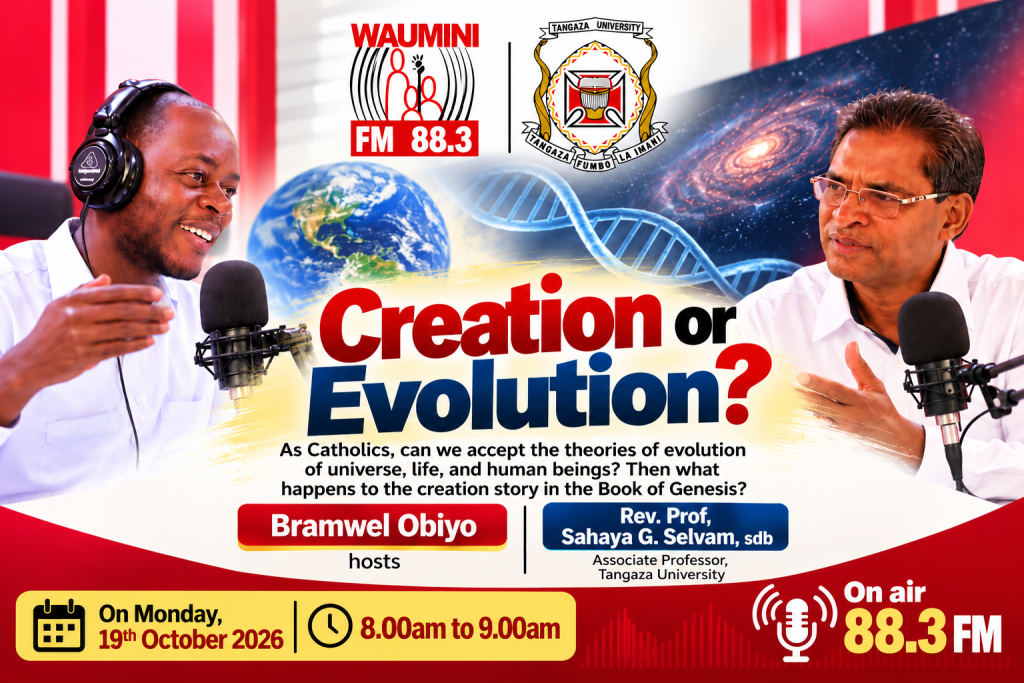
Watch recording of the radio show: https://www.youtube.com/watch?v=jmIILYL-vK8