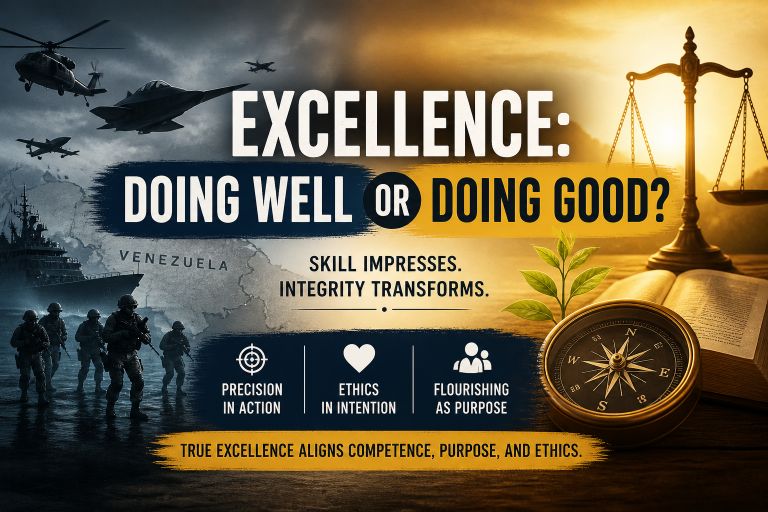
Early January 2026, the United States launched a military strike in Venezuela and captured incumbent president Nicolás Maduro and his wife. Later Trump in his inimical style prided to a journalist, “we have weapons nobody else knows about… we have some amazing weapons. That was an amazing attack.” He even shared on his Truth Social page a fake Wikipedia entry describing himself as the acting president of Venezuela.
Yes, America pulled off the “Operation Absolute Resolve” with impeccable precision, that is what the press reported. Yes, it was done well, but was it right, was it good? Was it ethical or even legal?
‘Excellence’ is an overused term these days. Often a mere capitalist marketing byline. Academic institutions aim at excellence in education. Service industry strives for excellence in customer care. Government agencies claim to deliver excellence in public administration.
The origin of excellence goes back to the Greek philosopher Aristotle. To him, it does not mean brilliance, prestige, or technical perfection. He uses the term aretē (virtue or excellence) to describe the full realisation of human purpose.
What is a human being for? According to Aristotle, human beings’ doing well is not measured in wealth, power, or pleasure, but in rational activity in accordance with virtue. The ultimate goal, which he calls eudaimonia (often translated as flourishing or well-being), is achieved not by isolated successes but by a consistent way of living a virtuous life.
So, excellence is not just doing well but doing good very well. It is not about just competence but ethics.
More recently, in positive psychology, the Good Work Project, led by Howard Gardner and colleagues, offers a more holistic framework. It defines “good work” as work that is not only excellent in quality but also ethical and meaningful. Excellence, in this view, is inseparable from responsibility. A task may be performed with extraordinary skill yet still fall short if it does not contribute to human flourishing or moral good.
It is an invitation to move away from our infantile admiration for raw competence and the idolatry of skills and knowledge as ends in themselves. Excellence is the consistent sensitivity to ethical concerns.
The question then is not “Was it done well?” but “Was it right to do at all?” Genuine excellence requires alignment between competence, purpose, and ethics.
Sahaya G. Selvam, sdb