 “And they all ate and were satisfied” (Mt 14:20)
One of my academic interests is to examine the psychological impact of Christian contemplative practice on people. A pattern emerges from the formal interviews that I have conducted, and the informal conversation that I have had. The participants speak of what I call, ‘a 3D spirituality,’ there is an upward movement of the heart towards God, there is an inward movement towards the self, and there is an outward movement towards others. This is something I strive for in my own personal life, and I offer opportunity for people to experience through my own ministry. These days I add a fourth dimension to this, inspired by the spirit of the Laudato Si’: the outward journey is also towards the rest of creation!
3D Spirituality. In the […]
Sunday Sermons
Sunday Sermons and Homilies
Sermon for 17th Sunday in Ordinary Time – Year A Homily: The Treasure

Often we confuse needs, wants, and likes. ‘Needs’ are those that are necessary to ensure a quality of life. ‘Likes’ are those that we desire to have beyond our needs, because they are nice and attractive. ‘Wants’ are our desires that we choose to add on to our needs. Sure, needs, likes, and wants are all relative to how individuals respond to possibilities that exist in their environment.
I tend to think, the fundamental needs of human being are rather universal and tend to be relatively stable: in terms of food, clothing and shelter. Legitimately, these needs can progress from the bare minimum to a comfortable level related to quality of life. But there is a threshold point in this progress.
Let me illustrate that with an example. The way we describe the need for […]
Sermon for 16th Sunday in Ordinary Time – Year A Homily: The Mustard Seed
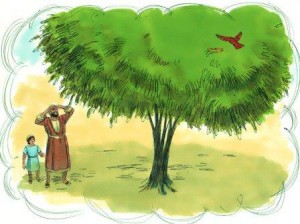 Believe in the principle of ‘graduality’!
These days, we in the world of “fast-food”! I have become increasingly impatient. When I go for breakfast I want instant coffee. When I have a headache I want instant relief. When I email people I want instant replies. When I fall in love I want instant pleasure. When I have problems I want instant solutions. When I pray I want instant miracles!
The Kingdom of God is not a Fast-Food Joint: In the gospel text of today, Jesus reminds me that in the Kingdom of God problems will be solved at their own time. Evil may grow together with good; evil will not be uprooted instantly. I need to wait patiently until the end of time (Mt 13:24-30). The Kingdom of God grows like a mustard […]
Sermon for 15th Sunday in Ordinary Time – Year A Homily: The Sower
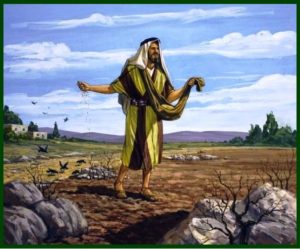
The Amateurish Farmer who does not expect 100% output
Jesus is a master storyteller. He uses vivid images drawn from everyday life to reveal deep truths about the Kingdom of God. And he chooses his imagery according to his audience. To shepherds and pastoral communities, he speaks of the shepherd and the lost sheep (Lk 15:3–7; Jn 10:1–18). To merchants and householders in towns, he tells parables of talents and pounds entrusted to servants (Mt 25:14–30; Lk 19:11–27). To fishermen, he speaks of nets and fish (Mt 4:18–22; Mt 13:47–50; Lk 5:1–11). To farmers, he draws on sowing, seeds, vineyards, and harvests, as in the parable of the sower today (Mt 13:3–9, 18–23; Mk 4:3–20; Lk 8:4–15).
However, there is something unusual about the story of today’s gospel. This is not the average […]
Sermon for the 12th Sunday in Ordinary Time – Year A Homily

12th Sunday – Cycle A
Do not be Afraid! (Mt 10:26-33)
One of the explicit characteristics of Matthew is that it was written in and for a Jewish community. Hence to understand that Gospel we need to be conscious of the Jewish background. Flowing from this setting, an interesting detail in the Gospel is that Matthew collects various sayings of Jesus delivered at different contexts into a compendium, breaks them into five parts, and places them at five locations, demarking the Gospel into “five-books” symbolically representing the five books of the Torah! Have a look at this:
Part 1 – Sermon on the Mount (Mt 5:1-7:29), at the beginning of the ministry of Jesus;
Part 2 – Missionary Instructions are collected in chapter 10;
Part 3 – Parables of the Kingdom in […]